
What do you see from this chart here? It’s not a Rorschach test:
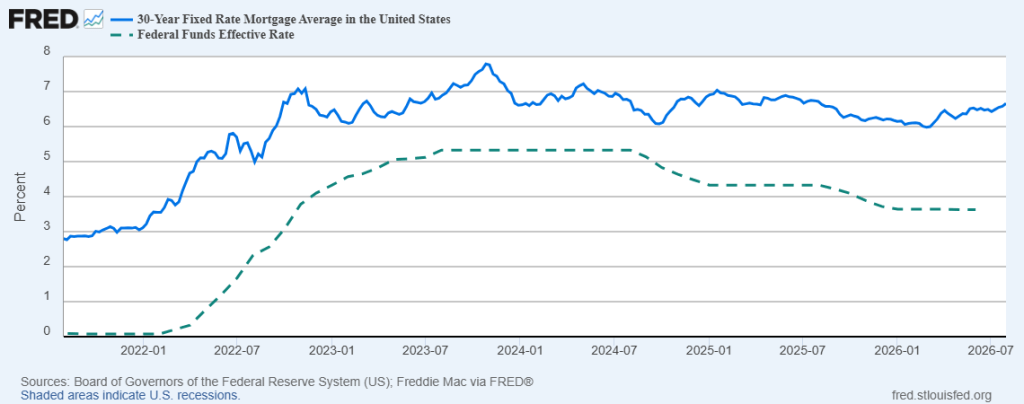
I see a range-bound 30 Year Fixed Mortgage Rate and the Federal Funds Rate that have basically held for about four years now. As you can see, after crossing the 6% threshold around September 15, 2022, other than a brief spike above 7% in the fall of 2023, we’ve basically bounced between 6% and 7%, while mostly trading around a 6.5% range. That’s where we are again now.
Within that construct, there have been three, maybe four depending on how you count them, windows of opportunity where rates were marginally lower, touching about 6%, give or take.
Of course these are average rates as listed by Freddie Mac’s surveys, so you can always buy a lower rate or choose to get a lender credit by taking a higher rate, but the range and opportunities still fit as outlined.
The Federal Funds Rate, meanwhile, is what the Federal Open Market Committee adjusts. That is an overnight lending rate at which banks lend money to each other. It’s not directly related to mortgage rates. As illustrated in this chart, looking at Oct. 2024, when the FOMC first cut interest rates in this cycle, mortgage rates actually increased. They did the same around each of the subsequent Federal Funds Rate cuts too. I’ve explained why that is in prior newsletters.
Where the Federal Funds Rate does matter to you is for your credit cards and home equity lines of credit. Those are typically based on the Prime Rate, which mirrors the Federal Funds Rate but it’s pegged at 3% higher. So when the Federal Funds Rate was at its recent high point of 5.25% between August of 2023 through August of 2024, Prime topped out at 8.25%.
Now, what do you see from this chart?
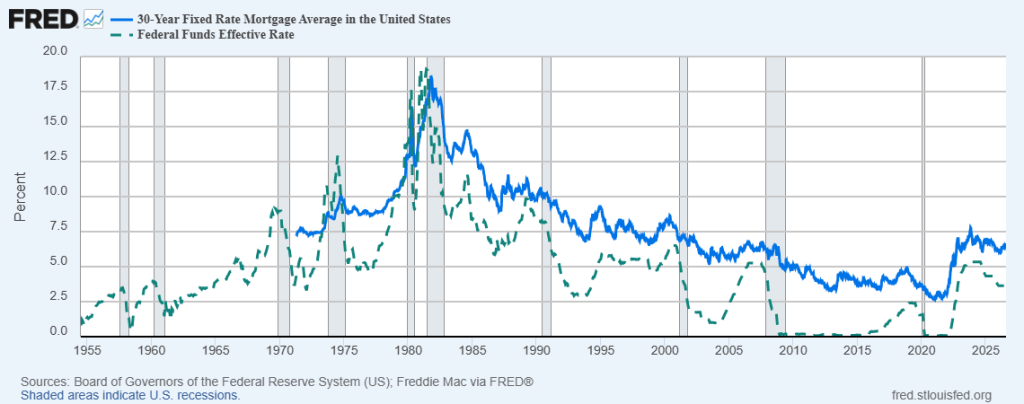
I see a few things when we zoom out.
First, the correlation between the Federal Funds Rate and mortgage rates looks stronger. And it is. That’s because, in general, in good economic times when everyone’s making money and feeling good about themselves, interest rates are higher. The Fed will push up on the lever of the Federal Funds Rate as a way of trying to stave off an overheating economy, which could lead to more inflation, by raising or keeping interest rates higher.
Meanwhile, investors in Mortgage Backed Securities demand a higher return/higher interest rate to buy those securities, because when things are going well, they can choose to park their money there, or in equities, which may have a higher return, but also a higher level of risk.
Second, I see that our current interest rate environment is nowhere near “high”. We all know this, but it’s really easy to forget, after seeing about a decade of unusually low interest rates, from the crash of the Great Recession in 2009, all the way through the Covid Pandemic. Today’s rates feel pretty well balanced, to me. I do think at some point 30yr fixed mortgage rates might settle back in the 5%s, but who knows? Some people think the AI revolution will displace so many workers the economy will tank, and we’ll see 2% 30 year fixed rates again. I’m not convinced that’ll happen, but who knows?
What I do know is my third observation from the chart above. It’s been a while since we’ve had a recession. Those are the grey bars. Are we due for one? Some people have been saying that a recession is right around the corner for years, too. Who knows?
But if you’re waiting for lower interest rates, what that means more often than not, is that you’re waiting for bad economic times. Interest rates are generally not lower during good economic times.
So what about the new Federal Reserve Chairman, Kevin Warsh? We’ve seen two FOMC meetings with him as the chairman now. He’s been on the job for a little more than two months.
My observations are that his history says he’s an inflation hawk. That is, until more recently, leading up to his appointment where he seems to have taken a more dovish stance. However, since becoming chairman, he’s said a few interesting things. In his prepared remarks after Wednesday’s FOMC meeting, leading into his Q&A with the media he said “Inflation remains elevated relative to the Committee’s 2 percent goal. The Committee remains resolute. You’ve heard this before, but we will deliver price stability.” And he continued a few sentences later “Let me reiterate: There is no soft inflation target, there is no soft implicit target —not on this Committee’s watch. There is only a target, and it is 2 percent.” (emphasis mine). Those are strong words. Will they be matched by actions? We’ll see.
The FOMC’s next meeting is in mid-September. They’ll have two more months of data on employment, inflation, and a host of other things.
It also strikes me that Warsh would like to see the Federal Reserves Open Market Committee have to pull fewer levers conducting monetary policy, relying more on the market finding equilibrium.
Continuing with his prepared remarks, Warsh stated “Two economic developments are worth highlighting. The first is a very notable change since our last meeting 42 days ago: nominal and real yields are materially higher across the Treasury curve. In fact, some of the increases in market interest rates between FOMC meetings are among the most significant in the last two decades, ranking around the top decile or so.”
He went on “But if the Committee didn’t change its policy rate, what happened? In the inter-meeting period, market attention centered on real data and real economic developments. Prices reacted in real time to incoming information, and the reduction in forward guidance may have been a factor. Market participants are learning to play the ball, not the referee—and market prices will continue to respond in the direction and magnitude they see fit. This is, in my view, a change for the better—and we are just getting started.”
That part is key. He’d like to lean on markets operating more independently from Federal Reserve monetary policy. I believe he thinks doing so, will allow whatever monetary levers the Fed does pull to have a greater impact when they’re needed, vs. their being relied upon to buoy the economic engine and markets more broadly.
In that vein, one of his primary missions is reducing the Fed’s balance sheet, which has exploded in size since the Great Recession. That balance sheet expansion alone promotes looser monetary policy. By shrinking the Fed’s balance sheet, that will be restrictive, without necessarily tightening interest rates.
We’ll learn a lot more about the Warsh Era as it progresses. In the meantime, my base case remains that mortgage interest rates will remain relatively flat, most likely within the same range we’ve seen for the last four or so years.
And if the Fed does raise the Federal Funds Rate in September? We might actually see mortgage rates decrease a sliver, responding to a sign that the Fed is serious about bringing inflation back down towards its 2% target. After all, inflation is the arch enemy of any fixed return investment.
In the meantime, if you, your family, clients or friends have any questions, or would like to discuss options for buying or refinancing a home or commercial property, don’t hesitate to call me. I’m always happy to be a resource.
Here’s how rates ended this week. Have a great weekend. E
| Conforming | Rates | Points | APR | Loan Amt | Payment | ||
| 30 yr fixed mortgage | 6.625% | 0 | 6.675% | $ 300,000.00 | $ 1,921 | ||
| 15 yr fixed mortgage | 6.250% | 0 | 6.300% | $ 300,000.00 | $ 2,572 | ||
| 30 Yr fixed FHA mtg | 6.000% | 0 | 6.850% | $ 300,000.00 | $ 1,799 | ||
| 30 Yr fixed VA mtg | 6.000% | 0 | 6.430% | $ 300,000.00 | $ 1,799 | ||
| Jumbo (ask me about Super Conforming limit, per your zip code) | |||||||
| 30 yr fixed mortgage | 6.625% | 0 | 6.801% | $ 1,200,000.00 | $ 7,684 | ||
| 15 yr fixed mortgage | 6.500% | 0 | 6.673% | $ 1,200,000.00 | $ 10,453 | ||
| 7/6 ARM | 6.375% | 0 | 6.575% | $ 1,200,000.00 | $ 7,486 | ||
| 10/6 ARM | 6.750% | 0 | 6.832% | $ 1,200,000.00 | $ 7,783 | ||
| Rates subject to change without notice. | |||||||
| Please keep in mind, these rates and statistics are for informational purposes only to give you a sense of market movement and my opinion as to why. Although these rates exist today, based on certain qualifying characteristics (780+ fico, owner occupied SFR with 75% loan to value ratio or less and $200,000+ loan amount), your scenario may allow for lower or higher interest rates. Licensed by the CA Dept of Real Estate, #01760965. NMLS: 239756. Equal Opportunity Housing Lender. If you’d like to be removed from this list, please reply with REMOVE in the subject line. You can also use this link, mailto:eric@ezmortgages.us and add REMOVE to the subject line. To add someone who would appreciate this information, send me their email with SUBSCRIBE as subject. | |||||||